
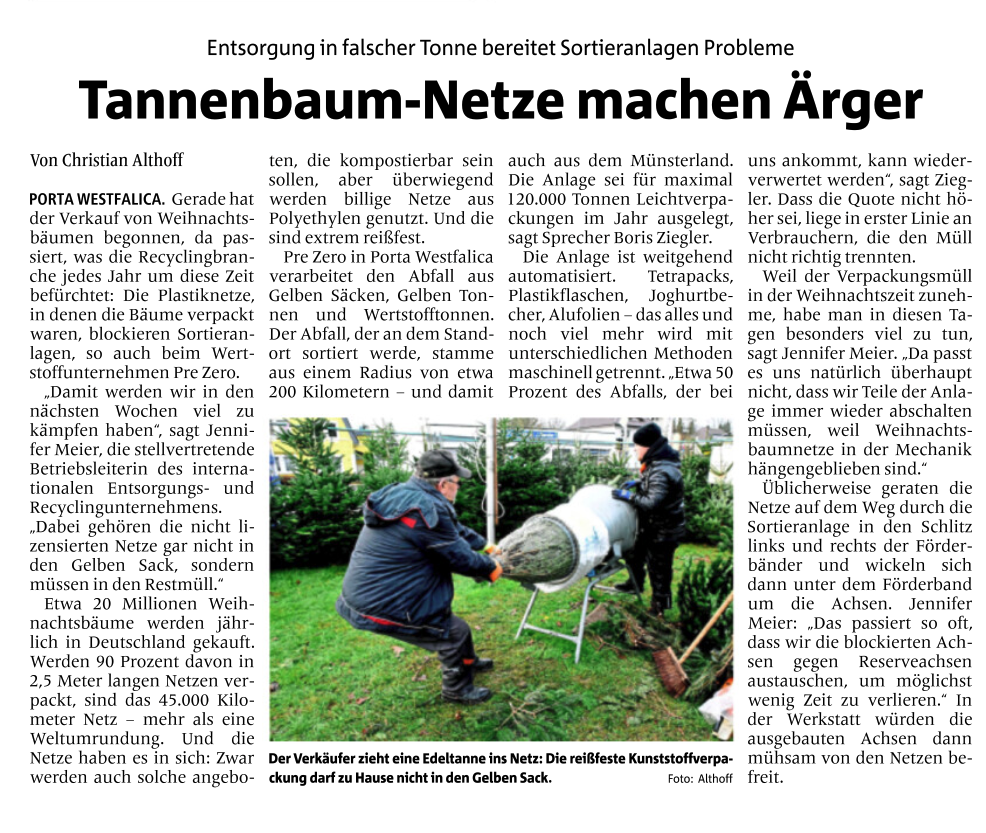
Plastic nets cause problems in the sorting facility
Source: MZ, 10 December 2025
Incorrect disposal causes problems in sorting facilities
Christmas tree nets create trouble
By Christian Althoff
PORTA WESTFALICA. The sale of Christmas trees has just begun, and what the recycling industry fears every year at this time is already happening: the plastic nets used to wrap the trees block sorting facilities, including those at the waste management company PreZero.
“We will have a lot to deal with in the coming weeks,” says Jennifer Meier, deputy operations manager of the international waste disposal and recycling company. “These unlicensed nets do not belong in the yellow recycling bag at all; they must be disposed of in residual waste.”
Around 20 million Christmas trees are purchased in Germany every year. If 90 percent of them are wrapped in 2.5-meter-long nets, that amounts to 45,000 kilometers of netting — more than a trip around the world. And these nets are tough: although some are advertised as compostable, the majority are cheap polyethylene nets, which are extremely tear-resistant.
PreZero in Porta Westfalica processes waste from yellow bags, yellow bins and recycling bins. The waste sorted at this site comes from a radius of around 200 kilometers — including the Münsterland region. The facility is designed for a maximum of 120,000 tons of lightweight packaging per year, says spokesperson Boris Ziegler.
The plant is largely automated. Tetrapaks, plastic bottles, yogurt cups, aluminum foil — all this and much more is separated mechanically using different methods. “About 50 percent of the waste we receive can be recycled,” says Ziegler. The reason the rate is not higher is primarily due to consumers not sorting their waste correctly.
Because packaging waste increases during the Christmas season, the workload is particularly high at this time, says Jennifer Meier. “It is extremely inconvenient for us that we constantly have to shut down parts of the plant because Christmas tree nets get caught in the machinery.”
Typically, the nets slip into gaps along the conveyor belts and wrap themselves around the axles underneath. Meier explains: “This happens so often that we replace the jammed axles with spare axles to avoid downtime.” In the workshop, the removed axles are painstakingly freed from the nets.